

At this time of year, I try always to be attentive to the wild little things that cling to the margins of the road and stake their claim in the wake of passing cars as well as the gentler, more domestic flowers that grow in the shelter of my garden. Every flower is different, of course, and for me their diversity is commensurate with their beauty. Snowdrops are shy and so furtively bend their hooded heads to the ground while other flowers are obscenely proud, standing to attention and boldly turning their faces to the sun, never letting it out of their sight until it has fallen behind the horizon. Some flowers are modest in monochrome while the brightly coloured petals of certain tulips and lilies are variegated with shocking white stripes – the splendid symptom of a deadly viral infection. In their difference to one another, all flowers are evidence of the nonhuman world’s staggering variety of forms. When one casts their eyes to the earth and meets the gaze of a flower, they dimly perceive the quiet churning of an ancient machine that commands the intentionality necessary to patiently shape each pistil, petal, and leaf for a specific purpose and the profound generosity to make each of them beautiful. Each flower has been individually sculpted by the centuries and now lies waiting in the tall grass to surprise us with joy and the nonhuman’s inexhaustible capacity for creativity.
It is, then, unsurprising that flowers in literature should be similarly diverse in their representations and meanings. What follows is an argument for embracing the multiplicity and heterogeneity of flowers in literature by exploring one critic’s approach to a brief passage in William Shakespeare’s Hamlet. I will recount Harold Jenkins’ informative exploration of Ophelia’s floral symbolism before turning a critical eye to his possibly restrictive motivations and making an argument for more open-ended readings of flowers.
Those of us who recall our secondary school English lessons are likely familiar with Ophelia’s ambiguous use flowers in Hamlet. The scene in which Ophelia bursts upon three of the play’s principal characters to distribute symbolically freighted flowers is memorable not only as a display of the tragic heroine’s burgeoning madness, but also as Ophelia’s first appearance as an outspoken, autonomous agent. Throughout Hamlet, Ophelia is directed and manipulated by the men who surround her. For instance, Polonius, Ophelia’s father, carefully instructs his daughter on how best to make herself appealing to Hamlet: ‘Walk you here’ he commands, ‘Read on this book, / That show of such an exercise may colour / Your loneliness.’ (III, I, 43-46) Ophelia is literally at her father’s beck and call and, of course, follows his ultimately ineffectual orders. Indeed, very little that Ophelia does is of any consequence to the play (see, Lyons, 1977, pp.61-2) and she is consistently represented as a character without power, autonomy, or impact.
The obedience and helplessness that characterises Ophelia’s behaviour makes her sudden dissent all the more striking. Following her father’s murder at the hands of Hamlet, Ophelia distributes flowers to the King, Queen, and her brother, Laertes: “There’s rosemary, that’s for remembrance – pray you, love, remember. Here is pansies, that’s for thoughts. […] There’s fennel for you, and columbines. There’s rue for you. And here’s some for me. We may call it herb of grace a Sundays. You must wear your rue with a difference. There’s a daisy. I would give you some violets, but they withered all when my father died. They say a made a good end.“ (IV, v, 173-83) As we shall see, many of these flowers hide thorns that prick with Ophelia’s harsh but honest criticisms. However, Ophelia’s meaning is at first difficult to grasp, obscured under layers of symbolism.
From the beginning, we understand that the flowers carry deeper significance; Ophelia points out herself that the pansies and rosemary she gives to her brother signify ‘thoughts’ and ‘remembrance’, perhaps hoping to rouse the memory of their murdered father. However, the meanings of the other flowers are not made so explicit. Our reading of the flowers is further complicated by the fact that Ophelia does not address the recipients directly and the text contains no stage directions indicating to whom she gives each flower. To understand the flowers’ meaning and to discover their recipients, readers often delve into the dark waters of Elizabethan symbolism.
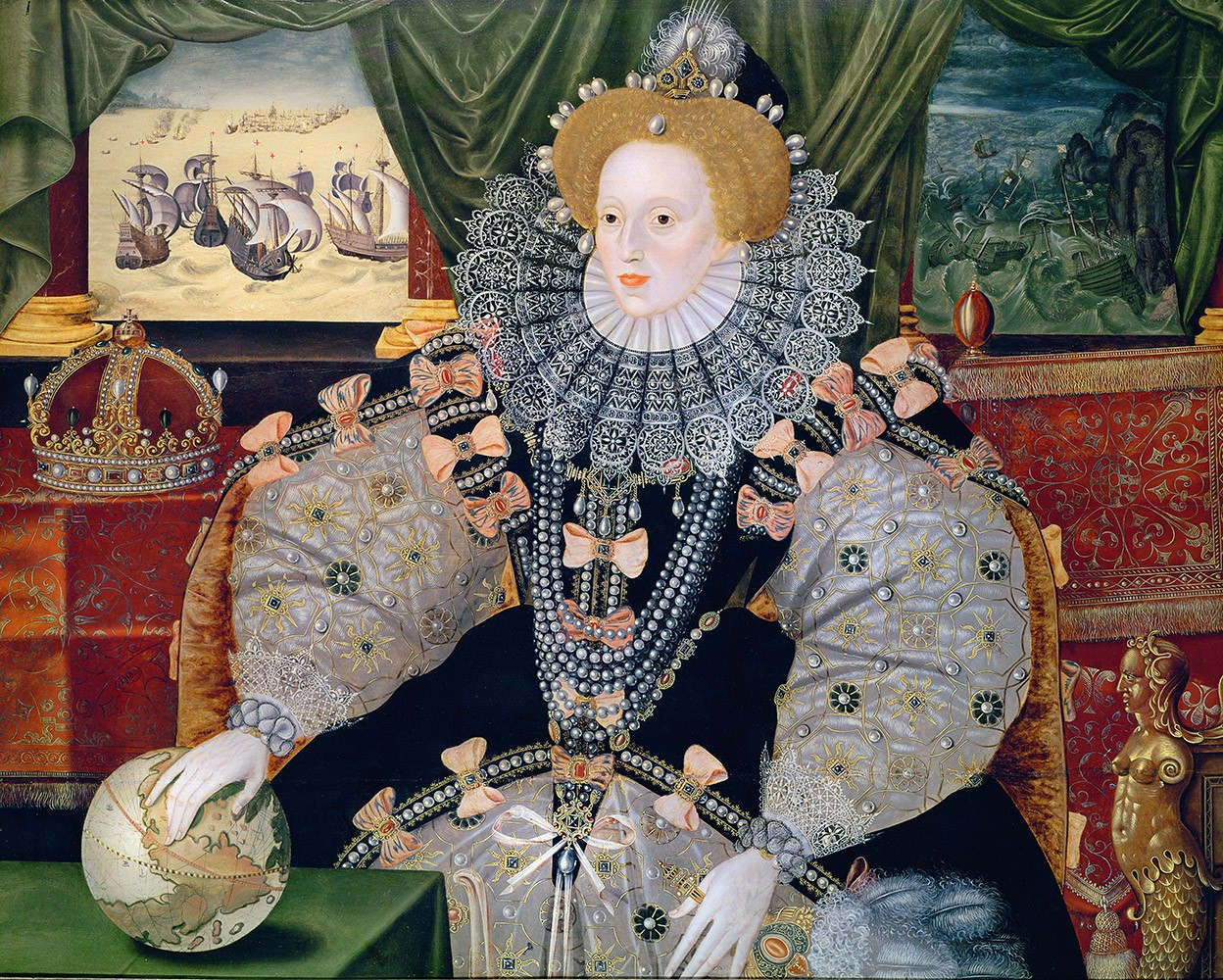
Elizabethan art, in its written and visual forms, is often richly textured with intricate symbolic networks. To get a feel for this, one need only look to the famous Armada Portrait of Elizabeth I and observe its clutter of symbols and iconography. It is often said when commenting on Ophelia’s flowers that, due to the period’s proclivity for diverse and often highly specific symbolism, Elizabethans were more accustomed to ‘emblematic usages’ than we are today and therefore would have been better equipped to identify the meaning of each flower (Jenkins, 1984, p.537). Following from this, Harold Jenkins seeks to uncover the hidden meanings in Ophelia’s flowers and clarify their intended recipients by way of texts contemporaneous to Hamlet.
Jenkins begins with Ophelia’s fennel and finds through several sixteenth century texts that the flower is typically emblematic of flattery and insincerity (p.538). Additionally, he finds reference in the work of the poet George Turbervile to fennel as ‘women’s weeds’ associated with willful and wanton behaviour (ibid). The columbines on the other hand, which appear to be paired with the fennel by Ophelia, where likely associated with cuckoldry by the Elizabethans, appropriate to the husbands subjected to it and their adulterous wives (Jenkins, p.539). Jenkins uses these associations to infer that the Queen is the intended recipient of the columbines and fennel. After all, as the Ghost explains earlier in the play, throughout her time as the old king’s wife the Queen’s virtuousness was insincere (I, v, 46) while her sexual promiscuity explains why she may be the natural recipient of the columbine. Here, then, we see Ophelia’s first floral indictment; through her emblematic flowers, Ophelia subtly exposes the Queen’s misdeeds.
With columbines and fennel explained and their recipient apparently found, Jenkins assumes the rue must be destined for the King. He explains that the rue’s significance can be traced through its homonym: to rue is to regret or to be repentant (Jenkins, p.539). Ophelia saves some rue for herself, perhaps signifying her sorrow over her father’s death or the loss of Hamlet’s affections, but notes that the king must ‘wear [his] with difference’. The King is, of course, a the repentant murderer (III, iii, 36-71) and so must wear his rue with shame to signify his feelings of guilt and remorse. Additionally, Elizabethan medical texts reveal that rue was typically used to assuage ‘carnal lust’ (Jenkins, p.540) and would therefore be an appropriate prescription for a man who lusts after the Queen and the power he wields as her husband. In the gift of the rue, then, we find another of Ophelia’s cutting criticisms aimed at a lecherous king whose crimes demand repentance.
The daisy comes next which, Jenkins admits, is one of the more vexing of Ophelia’s flowers. Jenkins traces a history of daisies’ place in literature from Geoffrey Chaucer, for whom daisies signified love, to Robert Greene who associates the flower with deception (Jenkins, p.540). Often, due to her troubled relationship with Hamlet being filled with false promise and deceit, commenters on the play suggest that Ophelia keeps the daisy or herself (see, for instance, Alexander Dyce’s A General Glossary to Shakespeare’s Work in which he asks ‘Does Ophelia mean that the daisy is for herself?’ and references Greene’s ‘dissembling daisie, [that] warne such light-of-love wenches not to trust every faire promise that such amorous bachelors make them’ [Dyce, 1904, p.197]). Jenkins, however, reads against this grain by pointing out that there are no grammatical markers to suggest that Ophelia intends the daisy for herself. He instead argues that the daisy is intended for Hamlet but that ‘in the absence of her lover it must go to whomever among those present her madness now substitutes for him.’ (p.541) For Jenkins, because there is ‘nothing to mark a change of recipient […] the King as the person last addressed must be the likeliest candidate’ (ibid). Although some may find his logic here somewhat expedient, as far as Jenkins is concerned, the daisy’s symbolic charge of dishonest love is directed towards Hamlet but is received in its material form by the King.
Jenkins next turns his attention to the final flowers in the passage: the violets. He finds that the Elizabethans associated violets with faithfulness in love. It would seem obvious, then, that these flowers are again destined for Hamlet. After all, the love he and Ophelia shared did indeed wither like the emblematic violets and Hamlet did kill Ophelia’s father. However, as Jenkins points out, this reading is troubled by the fact that Hamlet’s love for Ophelia died long before he became a murder. Instead, Jenkins suggests that the violets instead recall Polonius’ faithful and loving service to the Danish state (p.541). The withered violet thus reproachs a court that, since Polonius’ death, ‘knows faithfulness no more’ and so seems most appropriately directed to the leader of the court: the King (ibid). In this way, Jenkins seems to explain the last of Ophelia’s rebukes and so has apparently fully traced the meanings of her emblematic flowers.
There is a feeling of finality to the way in which Jenkins charts the meanings of Ophelia’s flowers that troubles me and brings me on to the meta-critical portion of my cursory look at Hamlet. When secondary school pupils or undergraduates are frustrated by an obscure symbol in a text, they may turn to a study guide for a clear-cut answer. For instance, if one goes to the website Shmoop’s study guide for Hamlet and reads the section on Ophelia’s flowers they will find this straight forward explanation: ‘Fennel symbolized strength and praiseworthiness, columbines symbolized faithfulness and modesty.’ (Hamlet Symbolism, Imagery, Allegory | Shmoop) Similarly simple, CliffsNotes connects rosemary to grief, pansies to remembrance, fennel to sadness, columbines to affection between lovers, and daisies to fertility (Hamlet — Symbols — CliffsNotes). In short, both of these study guides are happy to tell students that these symbols have fixed and accessible meanings.
The reader will no doubt notice that the meanings attributed by the study guides are different and sometimes heterogeneous to those drawn by Jenkins. However, I would argue that all three sources share a similar longing for closure and truth. Shmoop and CliffNotes would both lead one to believe that there is traceable and exact relationship between symbol and meaning; they behave like cheat sheets, comforting the student by telling them they can look up the true meaning of a symbol like the correct answer to a maths problem. Jenkins carefully researches a variety of Elizabethan texts, literary and otherwise, which inform his readings of Ophelia’s flowers. His analysis is much more detailed than either of the above-mentioned study guides and is certainly more aware of the complexity of the play and the period’s use of symbols. However, he still falls prey to a similar critical ideology which pushes one to seek a final and correct interpretation. This much is clear at the beginning of Jenkins’ analysis when he complains that readers today will never know ‘the authentic recipients’ of Ophelia’s flowers (p.537) as though the way in which modern productions and readers of the play interpret this scene and distribute its flowers are in some way inauthentic. Jenkins’ subsequent research is designed to discover who really received which flower in the play’s original performances. He works very much like a historian, assuming that there is correct account of events and using historical documents to reconstruct them as accurately as possible. Thus, though Jenkins does not claim he has discovered the true meanings of the symbols, his approach, presupposes that such meanings exist.
To me, the questions, ‘who were the authentic recipients of Ophelia’s flowers?’ or, ‘what are their correct interpretations?’ are questions wrongly asked. It strikes me that the ambiguity of Ophelia’s address, the lack of stage directions, and the flowers multifarious and at time heterogeneous associations all make the brief passage ambiguous and ultimately open-ended. This would have been likely been the case for the play’s Elizabethan audiences as well. As the critic Bridget Gellert Lyons points out, ‘flower symbolism, while not as arcane in the sixteenth century as it is now, was usually open even then to multiple interpretations’ (1977, p.65). Indeed, Lyons suggests that Ophelia’s attempts to use flowers to convey meaning ‘reveal the possibilities for obscurity and confusion that were latent in the language of flower symbolism.’ (p.67) Because of this, attempts to track down monolithic meanings and the authentic recipients of Ophelia’s flowers misread a scene that stands to emphasis the ambiguity and multiplicity of emblematic flowers and symbolism as a whole.
There are other fruitful ways to read the scene without attempting to decode its symbolic order. For instance, Lucile Newman presents a fascinating botanist’s perspective when she abandons symbolism and reads the flowers more literally. Through sixteenth century sources, Newman explains that the rosemary, rue, and fennel were commonly used to provoke abortions by the Elizabethans (1979), a claim that invites further consideration of the extend and outcome of Ophelia and Hamlet’s romantic involvement. Newman’s research shows us that reading Ophelia’s flowers as obscure symbols that conceal deeper meanings lost to us moderns is not the only or even the most profitable course of analysis.
Ultimately, I don’t wish to discredit Jenkins’ careful and informative work on Ophelia’s flowers. I only want to question reading strategies that seek ‘satisfactory elucidation’ (Jenkins, p.536) rather than organic exploration. When we read flowers in literature, we should always keep in mind the diversity of flowers in nature. Flowers are never just one thing and we should always endeavor to embrace their variety and multiplicity.
Sources:
Dyce, Alexander. 1904. A General Glossary to Shakespeare’s Work, Vol. 1 (Boston: Dana Estes and Company)
Jenkins, Harold. 1982. ‘Longer Notes’, Hamlet (Surrey: Thomas Nelson)
Lyons, Bridget Gellert. 1977. ‘The Iconography of Ophelia’ in ELH, 44:1, pp.60-74
Newman, Lucile. 1979. ‘Ophelia’s Herbal’ in Economic Botany, 33:2, pp. 227-32