

We haven’t been on here for a little while, and at least I haven’t been writing for at least as long as my last prompt post. So with some free time coming up in the next few weeks, I have decided to attempt a write a book in 30 days challenge. For many years I had fully intended to take part in the NaNoWriMo and now it is gone so 2024 was the last time I could fail to commit to it.
With this NaNoWriMo website not being accessible, I have been researching online for useful guides/tips from other writers who have taken part or have completed a similar challenge or who just really really needed to get passed the first few 100 words. With their help, I have come up with kind of a plan that I will detail below. Now as I say I’m bringing other peoples advice together and haven’t tried this plan yet so there are no guarantees but here we go!
Pre-Planning
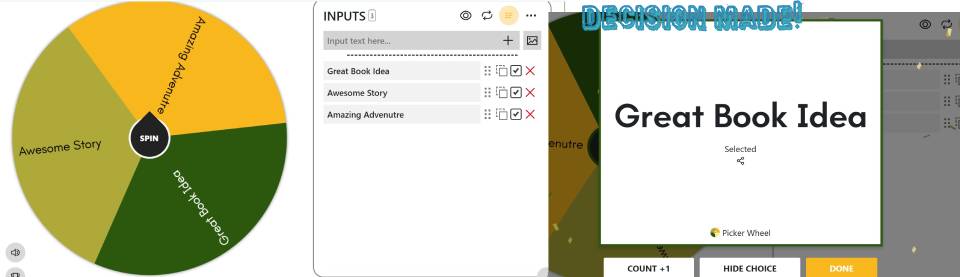
The majority of writers who completed NaNoWriMo including Tim Jonze without any kind of plan, believe that the quality of their writing suffered due to this. So if like me you have had several book ideas swirling in and out of your thoughts for a long time, it’s time to decide which idea you want to go with for the challenge. If you have 2 ideas toss a coin, if you have more than 2 ideas then a dice or pickerwheel can be put to use – and remember if you are disappointed with your result then it might be because deep down you already know the idea you want to concentrate on.
Stage 1 – Gather and Develop Your Thoughts
Now different articles offer different ideas of how to go about this stage. The Wordling suggests a summary and an outline, where Kezla Newson proposes creating a more visual representation through creating a mood board, and creating a playlist that helps to immerse you in the world of your book. There is some argument over how much you should plan, with many including NY Book Editors warning that there can be such a thing a over planning which could ruin the story. Well known authors use a range of planning techniques some opt for fully detailed plans, others use notes and character development and some opt to “Fly by the seat of their pants”, so it is clear that there is not a one size fits all. At the moment I am planning to host a creative workshopping day for me and some fellow…need to get back into it creatives to see what we can come up with! I do like the idea of the mood board, and immersing yourself in your books environment so this will get incorporated into the day! I will report back how this turns out.

Photo by Jordanhill School D&T Dept https://commons.wikimedia.org/wiki/File:Mood_Board.jpg


Photo by Mateusz Dach: https://www.pexels.com/photo/fashion-collage-attached-to-wall-4466999/
Stage 2 – Pick a start date!
I don’t want to set myself up to fail on this so although my holidays start on the 3rd of July, I know that I am going to be away the following week so I don’t want to get started and then stop for a big gap, this has never once worked for me with anything I have planned to do including writing previously. So with that in mind I am going to set my start date for Wednesday 16th July which will give me until Sunday the 17th of August to complete my book writing goal.
Stage 3 – Plan your writing time!
Number of words
Most articles including this one by Abi Wurdeman about starting writing schedules you can stick to recognise that while a schedule will help you reach your writing goals, sticking to the schedule can be tough. There are however ways you can make a schedule easier to commit to. One of the first things to decide is how long the book will be. Krytsle Appiah in her post on The Novelry breaks down word count by genre and type of story, which is useful to help estimate your word count. At the moment (pre planning) I think mine will fall into Young Adult or New Adult which both range from 50,000 to 90,000 words. As the time frame is fairly short then it make sense to aim for the lower end so 50,000 it will be. Meaning that if you break this down simply by dividing by days the aim is 1613 per day. It is important to recognise that there will be days and block of time that will not be available to write; while some writing may be possible it is unlikely to be as substantial at 1613 on these days.
Words per hour
The next consideration is how many words an hour are likely to be achieved, Peter Lyle DeHaan discusses that writing speeds can range from 100 to 2000 words which seems like a fairly massive difference and 1613 words a day would be unachievable if I only aim to write 100 words an hour. Given my failure to write more than a few 100 words at a time I also think aiming over 1000 an hour would be setting myself up for failure and I want to do everything I can to succeed with this challenge. So balancing this with not being able to write 1613 every day aiming for 400-500 words per hour and writing 2000-2500 a day seems challenging but possible which means scheduling 6 hours of writing a day. This will be broken down into different blocks based on what else I plan to do that day but a regular day might look like:
Basic Day
8am – 10am Writing
10am-11am Walk
11am to 11:30 Coffee
11:30am to 1:30pm writing
1:30pm – 2:30pm lunch
2:30pm – 3:30pm Gym
3:30pm – 5:30pm Writing.
I will share my weekly schedule, with updates on my word count as the challenge runs. So let’s see how I get on! :